
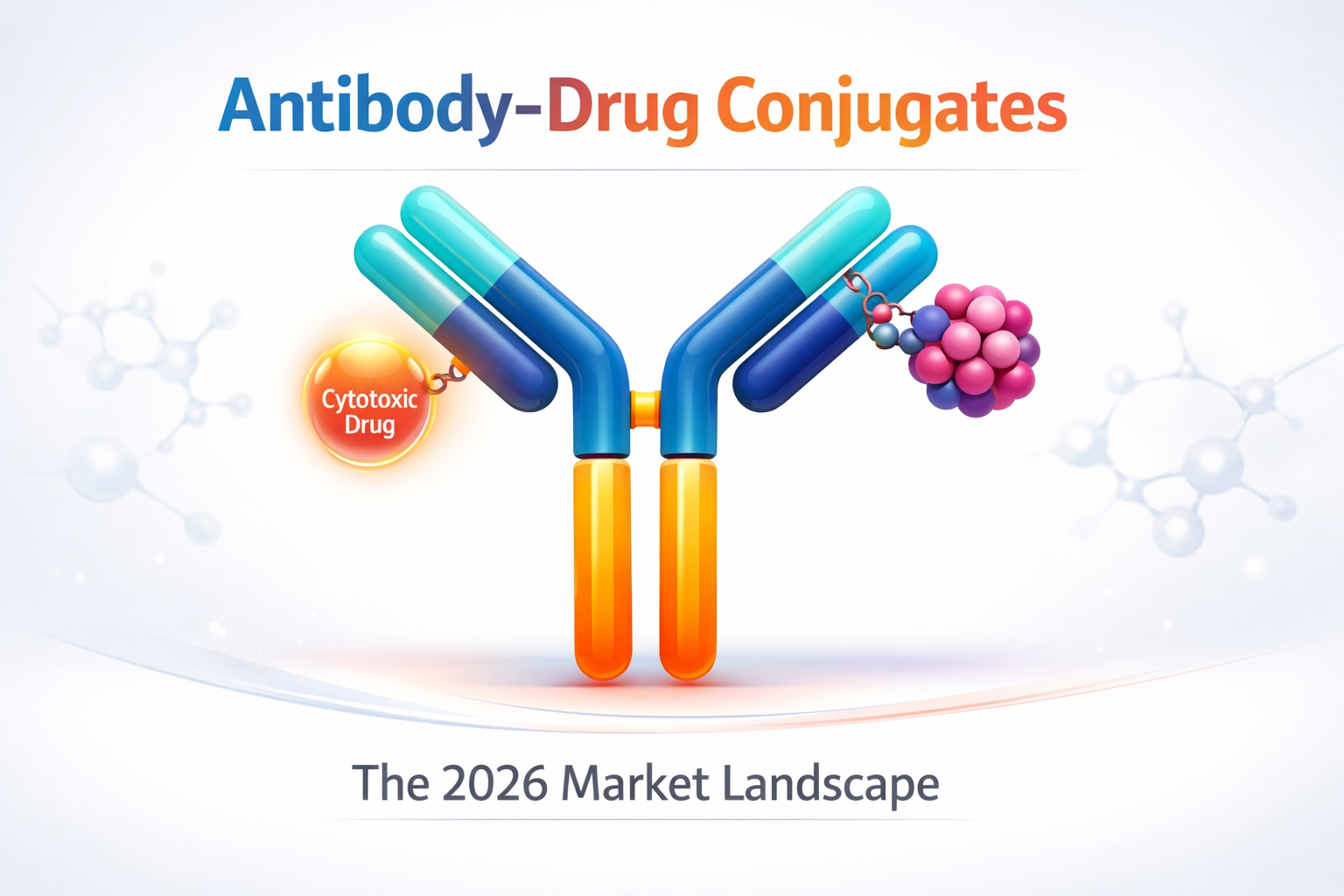
The Antibody-Drug Conjugates market trends for 2026 reflect a transformative shift toward “biological missiles” that redefine cancer care. Antibody-drug conjugates (ADCs) are a rapidly evolving class of therapeutics designed to deliver potent cytotoxic drugs directly to tumor cells, limiting the off-target toxicities of systemic chemotherapy. [1] As of early 2026, the global ADC market has surpassed $14 billion in annual valuation and is projected to reach $23 billion by 2030, with aggressive estimates suggesting a trajectory toward $35 billion by 2035. [2]
Technical Composition and 2026 Mechanisms
Modern ADC architecture focuses on enhancing the “therapeutic window”—the balance between killing cancer and sparing healthy tissue. An ADC consists of three primary components: a monoclonal antibody, a cytotoxic payload, and a chemical linker. [3]
- Antibody: Precision-engineered to target specific antigens like HER2, FRα, ROR1, or B7-H4. [4]
- Payload: 2026 standards favor Topoisomerase I (TOP1) inhibitors (e.g., Exatecan) and microtubule inhibitors (e.g., MMAE). [5]
- Bystander Effect: Payloads like MMAE can diffuse from the target cell to kill neighboring “cold” tumor cells, essential for treating heterogeneous tumors. [6]
Emerging Next-Generation Innovations
To stay ahead of Antibody-Drug Conjugates market trends in 2026, developers are moving beyond simple “one antibody, one drug” formats to overcome resistance.
Dual-Payload and Bispecific ADCs
Companies like Alphamab Oncology are pioneering “2-in-1” designs. Their candidate, JSKN021, is a first-in-class dual-payload bispecific ADC targeting EGFR and HER3. It utilizes both a TOPO1 inhibitor and MMAE to address tumor heterogeneity. [7]
Advanced Bioconjugation and iADCs
Whitehawk Therapeutics is utilizing optimized DAR6 (Drug-to-Antibody Ratio) configurations to enhance stability and prevent premature payload release. [8] Simultaneously, Sutro Biopharma is advancing Immunostimulatory ADCs (iADCs), which combine cytotoxins with STING agonists to trigger an immune response alongside direct cell death. [9]
Key Market Players and Pipeline Assets
The following table outlines the high-impact clinical assets defining the Antibody-Drug Conjugates market trends for 2026.
| Company | Key Candidate | Target/Mechanism | 2026 Status |
|---|---|---|---|
| GSK | Blenrep | Anti-BCMA | FDA Approved (Oct 2025) [10] |
| NextCure | LNCB74 | B7-H4 (MMAE) | Phase 1 Update (H2 2026) [11] |
| Alphamab | JSKN021 | EGFR/HER3 Bispecific | IND Accepted March 2026 [7] |
| Zymeworks | ZW191 | FRα (FR-alpha) | Clinical-stage [12] |
Manufacturing and Strategic Trends in 2026
Complexity in bioconjugation has led to a surge in specialized CDMOs. Firms like TOT Biopharm have expanded commercial lines to handle “XDC” (X-drug conjugate) manufacturing requirements. We are also seeing a heavy “East-to-West” licensing trend, where firms like ArriVent and Crescent Biopharma license assets from Chinese innovators to accelerate global market entry. [13]
References
- [1, 8] Whitehawk Therapeutics Corporate Overview (2026)
- [2] Precedence Research: ADC Market Forecast 2026-2035
- [3, 5, 11] NextCure Business Update (Jan 2026)
- [4, 10] FDA Approval: Belantamab Mafodotin (Blenrep)
- [6, 9] Sutro Biopharma Corporate Presentation (Aug 2025)
- [7] Alphamab Oncology JSKN021 IND Acceptance (March 2026)
- [12] Zymeworks Pipeline Overview (2026)
- [13] Stock Titan: NextCure/Simcere Licensing Milestones